Choosing a construction company in Islamabad is one of the highest-stakes decisions a plot owner ever makes. The right firm keeps your project on schedule, inside its budget, and structurally sound for decades. The wrong one leaves you paying twice, first for the original construction and again for the repairs that follow within a couple of years.
This guide is written for people who are actively evaluating construction companies across Islamabad and Rawalpindi, not for those still deciding whether to build. It walks through how to shortlist a firm, what services a competent contractor should offer, how pricing actually works, how long a project genuinely takes, and the warning signs that separate serious construction companies from the ones you should quietly move past.
Both cities are covered throughout. Islamabad and Rawalpindi function as a single construction market for most homeowners, but each has its own approval authority, land pricing, and neighbourhood quirks that a good contractor should understand.
What makes a construction company worth hiring in Islamabad
Before naming any type of firm or approach, it helps to fix a mental checklist. Serious construction companies in Islamabad tend to share the same operational habits, and you can test for these on a single site visit or a first phone call.
A signed, itemised construction agreement
A verbal quote is not a contract. A proper construction agreement should list the scope of work, materials specification, payment stages tied to construction milestones, timeline with penalty clauses, and warranty terms. If a company resists putting these on paper, that is a decision-grade signal on its own.
An engineer or architect on site, not only on paper
Ask who will visit the site and how often. A construction company that quotes a low price by cutting the site engineer is transferring risk to you. Concrete pours, steel placement, plumbing rough-ins, and electrical conduit runs all need someone technical present when the decisions get made.
A written BOQ (Bill of Quantities)
The BOQ breaks the entire project into measured items with rates. A firm that gives you only a lump sum has either not costed the project properly or is protecting margin they do not want you to see. Insist on line-item BOQs before signing anything.
Approved drawings before excavation
Structural, architectural, and MEP (mechanical, electrical, plumbing) drawings should be finalised and approved by the client before ground is broken. Companies that start digging with rough sketches almost always run into coordination problems that surface as “extra cost” invoices later. This is one of the most common patterns behind projects that overrun their original quote.
A visitable, recent portfolio
Photos are useful but weak evidence on their own. Ask if you can visit two or three completed or under-construction projects. Any serious construction company in Islamabad should have addresses they are comfortable sharing, ideally within DHA, Bahria Town, Gulberg Greens, or a Rawalpindi society you already know.
Types of construction work these companies handle
Construction firms in the twin cities usually specialise in one or two of the categories below. Matching your project to the right kind of firm is a bigger predictor of success than the firm’s general reputation.
Residential construction (houses on marla and kanal plots)
The bread-and-butter of Islamabad construction. Firms working on 5 marla, 7 marla, 10 marla, 1 kanal, and 2 kanal houses have refined systems for each size band. A firm that has built forty 10-marla houses will run yours faster and cleaner than a firm doing its second.
Commercial construction (offices, showrooms, plazas)
Commercial construction is a different discipline. Steel, larger spans, MEP systems, fire compliance, and stricter approval processes at both CDA and RDA make this a specialisation, not a size upgrade of residential work. If you are building commercial, hire a firm whose portfolio is genuinely commercial.
Turnkey construction (single contract, single handover)
In a turnkey arrangement, the construction company handles design, approvals, structure, finishing, and often furnishing under one contract. You hand over a plot and receive keys. This suits clients who want a single point of accountability, especially non-resident owners building from abroad.
Grey structure only versus full finishing
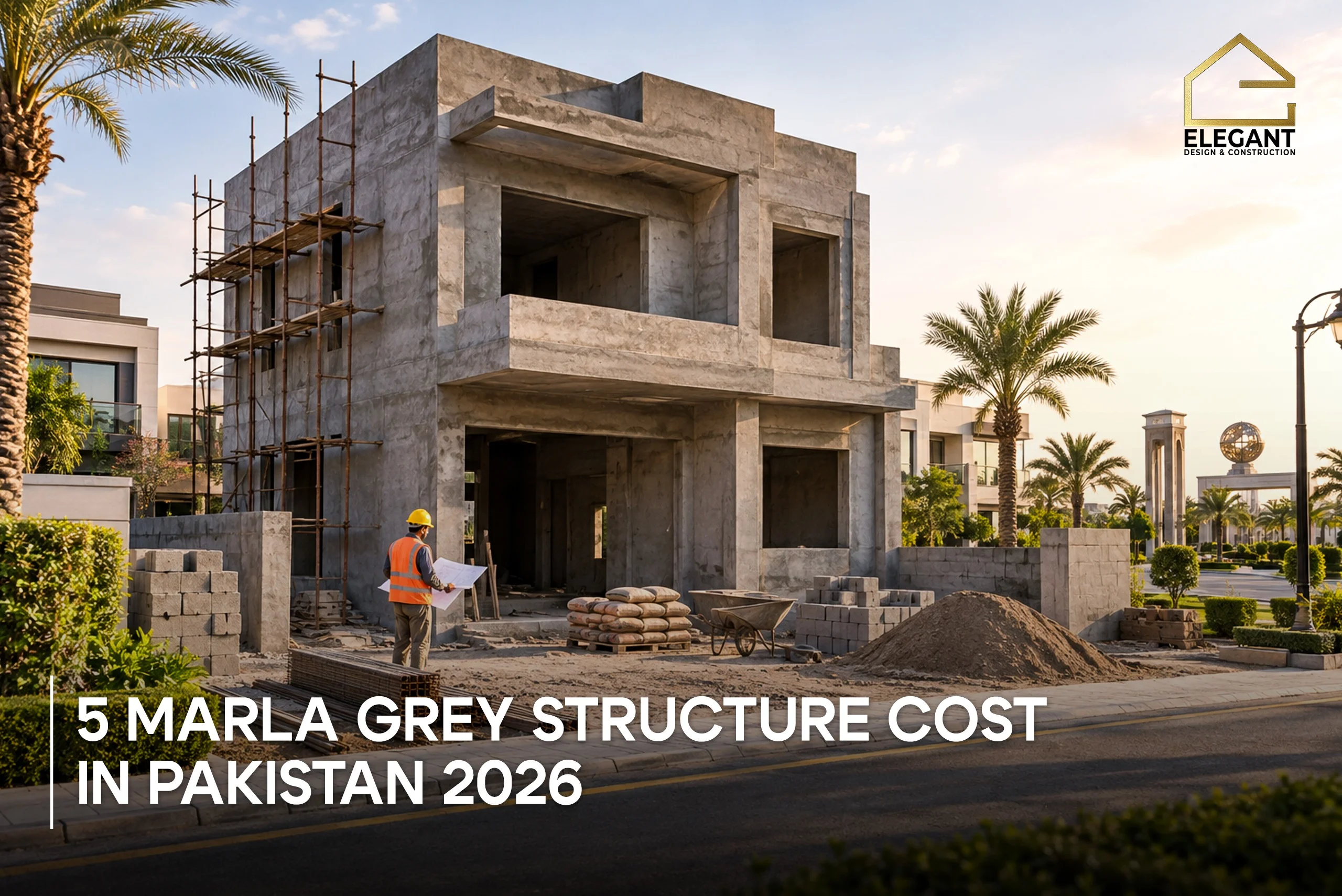
Some clients hire one firm for grey structure (the load-bearing shell, brickwork, roof, and plaster) and a different firm for finishing (flooring, paint, kitchens, wardrobes, sanitary, electrical fittings). This can work, but coordination between the two firms becomes your responsibility. A single firm handling both usually produces a cleaner handover, though it costs slightly more.
Renovation and remodelling
Renovation is technically harder than new construction because you are working around existing utilities and structural constraints you cannot see until you open a wall. A firm that is excellent at new builds is not automatically good at renovation. If your project is a remodel, ask specifically about renovation experience.
Areas of Islamabad and Rawalpindi where these companies work
Serious construction firms cover most of the twin cities, but neighbourhood familiarity matters. Each area has its own approval authority, plot sizes, common build styles, and even standard truck-access constraints that experienced site teams already know.
Islamabad neighbourhoods
DHA Islamabad, Bahria Town, Gulberg Greens, Bani Gala, and the numbered sectors (E, F, G, I) each have their own submission process, plot size norms, and design conventions. DHA and Bahria have internal approval processes on top of CDA, which adds days rather than weeks if the firm knows the system.
Rawalpindi neighbourhoods
Bahria Town Rawalpindi, Chaklala Scheme, Adiala Road societies, and older cantonment areas each have their own logistical realities. RDA governs approvals for most of Rawalpindi outside cantonment areas. If your plot is in Rawalpindi, hire a firm that has recently completed work under RDA, not one that only quotes CDA experience.
Twin-city construction crews
Most established firms in Islamabad also work in Rawalpindi and vice versa. The one operational difference worth asking about is where the labour is housed. A crew based on the Rawalpindi side saves an hour a day if your site is in Bahria Town Rawalpindi rather than G-13.
What to expect from an end-to-end construction project
Understanding the phase sequence helps you judge any timeline a firm quotes you. If a company promises to hand over a 10 marla house in four months, they are either skipping phases or hoping you will not check.
Phase 1: Design and drawings (3 to 6 weeks)
Architectural design, structural design, and MEP coordination. If this phase feels rushed, the coordination problems will show up on site later.
Phase 2: Map approval (2 to 8 weeks depending on authority)
CDA, RDA, DHA, Bahria, or the relevant cantonment board. Timelines vary. A construction company that has recently submitted to your specific authority will know the current queue.
Phase 3: Soil testing and site preparation
Skipping soil testing is a false economy. A soil report guides foundation design and saves rework on load-bearing walls.
Phase 4: Grey structure
Excavation, foundations, columns, beams, slabs, brickwork, roof, and plaster. Typical range: 3 to 6 months for a residential build, depending on size, weather, and material availability.
Phase 5: MEP rough-ins
Plumbing, electrical, and HVAC conduits and rough pipework installed inside the grey structure before finishing begins. Coordination between MEP and structure is where many projects lose time.
Phase 6: Finishing
Flooring, plaster refinement, paint, doors, wardrobes, kitchens, sanitary fittings, electrical fittings, and exterior work. Typical range: 3 to 5 months for a residential build.
Phase 7: Handover
Snagging, defect fixes, final cleaning, and utility transfers. A firm that skips a formal snag list is a firm that will disappear when you find defects a month later.
Realistic total build time: A 5 marla house typically takes 8 to 10 months from ground-breaking to handover. A 10 marla house takes 10 to 14 months. A 1 kanal house takes 12 to 18 months. Firms quoting materially faster are usually optimistic on paper and average in practice.
How pricing works: what genuinely drives cost
Two quotes for the same 10 marla house can differ by 40% between two competent firms. The gap is almost never dishonesty. It is specification level, material tier, and supervision model. Understanding which of these you are actually buying prevents most quote-comparison mistakes.
Specification level
Grey structure specification (steel grade, cement brand, brick quality, slab thickness) can vary widely within “standard” quotes. Ask for the specification sheet, not just the total price.
Material tier for finishing
Finishing has the widest cost range in any construction project. Sanitary fittings alone can vary by a factor of five between economy and premium tiers, and finishing typically represents 40 to 50 percent of the total cost of a new house.
Supervision model
A firm sending an engineer daily costs more than one sending a foreman with weekly engineer visits. The difference in outcome is usually visible within the first month of work.
Location and access
Sites with narrow access, restricted timing (some societies limit construction hours), or long distances from material suppliers cost more to run. Firms familiar with your specific area will price these constraints accurately rather than absorbing them into hidden overruns.
Note: This article deliberately avoids listing per-square-foot rates. Rates change with cement, steel, and finishing prices every quarter. If you want current numbers, see our regularly updated cost pages linked at the end of this article.
Red flags: how to spot a construction company you should avoid
Most construction projects that fail in Islamabad and Rawalpindi fail for a small set of predictable reasons. If a company shows any two of the signals below, treat it as a decision to walk away, not a negotiation to fix.
- Refusal to itemise a BOQ. Lump-sum-only quotes protect the firm and expose you.
- Reluctance to sign a written agreement. If they will not commit on paper, they will not commit on site.
- No engineer on staff. A firm without in-house engineers is coordinating your project through freelancers who are not accountable to the firm you hired.
- No addresses you can visit. Every serious contractor has recent projects they are proud to show.
- Aggressive upfront payment demands. A reasonable firm ties payments to construction milestones, not to the calendar.
- Quotes materially below the market range. Extreme underbidding almost always resolves as either quality cuts, midway cost escalations, or an abandoned project.
- No structural drawings or unwillingness to share them. Structural drawings are not proprietary. If they cannot produce them, they are not the ones doing the engineering.
What to bring to your first meeting with a construction company
The first meeting sets the tone of your working relationship. Coming prepared filters serious firms from sales-focused ones quickly, because a serious firm will engage with your details and a sales-focused firm will steer the conversation back to their brochure.
- Plot documents: Approved layout plan, allotment letter, and any prior approvals.
- Plot dimensions and orientation: Marla or kanal size, road frontage, and cardinal orientation for sunlight planning.
- Budget band, not a single number: Give a realistic range. A firm that immediately promises to hit the lower end of your range without seeing drawings is telling you what you want to hear.
- Timeline expectation: Occupancy target with any hard dates (school start, wedding, tenant move-in).
- Reference photos of finishes you like: Faster than describing them. Firms understand visual references immediately.
- Any prior architect drawings: If you already have a design, bring it. If not, that is fine, discuss whether the firm will design in-house or coordinate with your architect.
Questions to ask before you sign a construction contract
How do I verify a construction company in Islamabad is legitimate?
Ask for the firm’s registration, bank details on official letterhead, and two or three addresses of recent completed projects you can visit. Cross-check any team members named as engineers against the Pakistan Engineering Council database if the project is significant.
What is the difference between grey structure and turnkey construction?
Grey structure covers the load-bearing shell, brickwork, roof, and internal plaster. Turnkey covers everything from design through finishing and sometimes furnishing, delivered under a single contract with a single point of accountability.
How long does it take to build a 5 marla, 10 marla, or 1 kanal house?
Realistic ranges are 8 to 10 months for 5 marla, 10 to 14 months for 10 marla, and 12 to 18 months for 1 kanal. These assume normal weather, no major redesigns, and a firm working full-time on your project.
Do I need CDA or RDA approval before construction starts?
Yes for almost all plots. CDA governs most of Islamabad, RDA governs most of Rawalpindi outside cantonment areas, and DHA and Bahria have their own internal approval layers on top. Starting without approval risks demolition orders and legal exposure.
What should a proper construction agreement include?
Scope of work, itemised BOQ, materials specification, payment schedule tied to construction milestones, timeline with penalty clauses for both sides, warranty terms, and a defined change-order process for any additions or modifications.
Can one company handle both design and construction?
Yes. Firms offering design-and-build under one roof usually give you smoother coordination between the architect and the site team. Firms that only build to your architect’s drawings can also work well, provided the architect stays involved during construction.
Do you work in Rawalpindi as well as Islamabad?
Yes. Elegant Design and Construction handles projects across both cities, including Bahria Town Rawalpindi, Chaklala Scheme, and DHA Islamabad, Bahria Town Islamabad, Gulberg Greens, and the numbered sectors.
Ready to talk to a construction company that treats your project seriously?
Every project starts with a conversation, not a quote. If you are evaluating construction companies in Islamabad or Rawalpindi and want to see how we approach design, engineering, and site supervision, we would be happy to walk you through our process and show you completed work in your area.
Bring your plot details and a rough budget band. We will tell you honestly whether we are the right fit for your project and, if we are not, help you think through what you should be asking other firms.
Contact Elegant Design and Construction or browse our recent projects to see how we work.