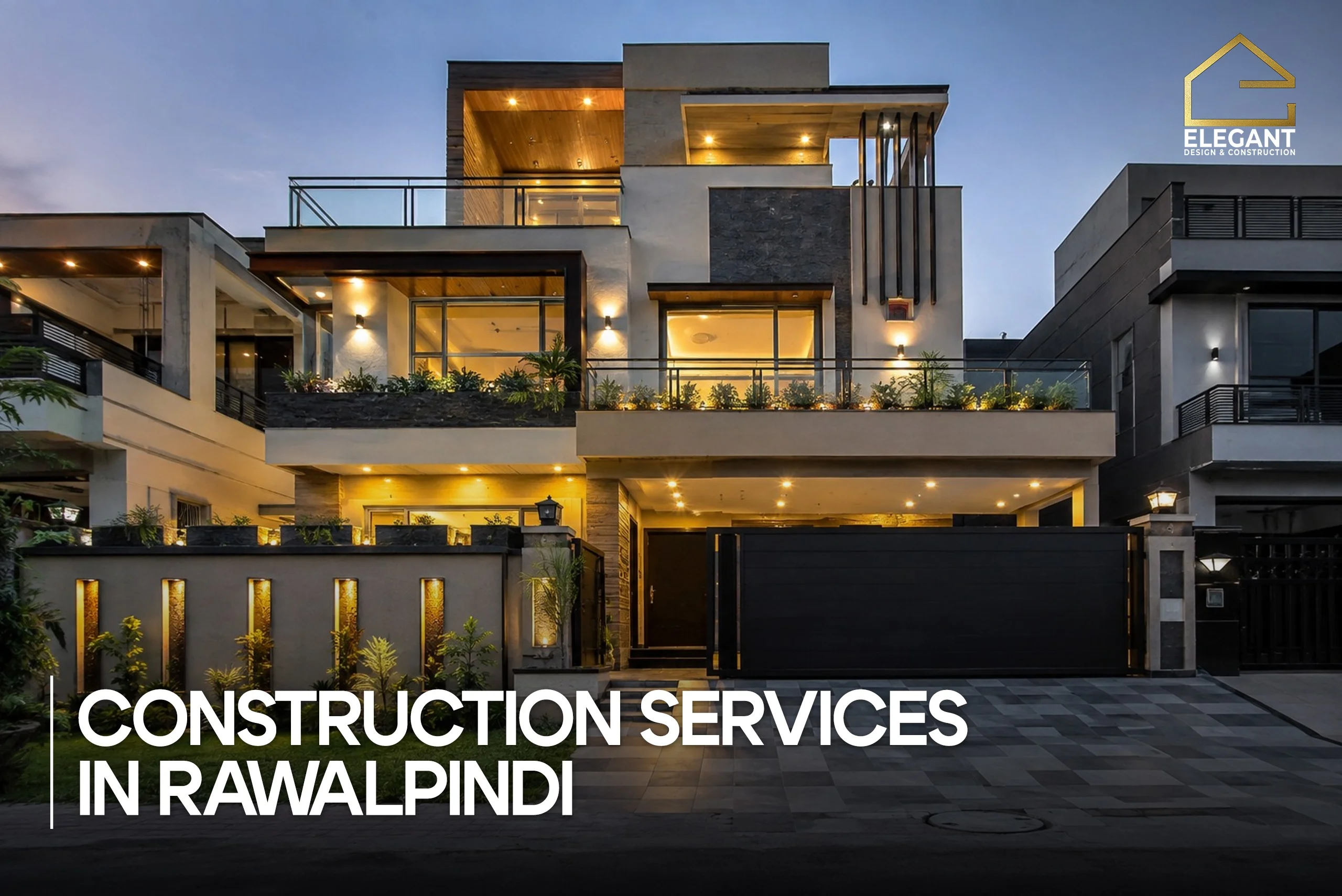
What Islamabad and Rawalpindi homeowners are actually building — and why it looks so different from five years ago.
Walk through a construction site in DHA Phase 2 or Bahria Enclave today, and something feels different from five years ago. The floor plans are different. The questions clients ask are different. The fixtures arriving in crates from Dubai are different. Even the conversations between architect and homeowner are different — longer, more specific, full of references to rooftop terraces and solar load calculations, and whether the home office needs a separate entrance.
Something has quietly shifted in how Pakistani families think about home. It is not just the cost of steel or the price of a bag of cement, though both have climbed steeply. It is deeper than that. The way people live has changed, and their homes are finally catching up.
Let’s discover what is actually happening on the ground in Islamabad and Rawalpindi in 2026 — the social forces, the lifestyle shifts, and the design decisions they are producing.
If you are planning to build or renovate in the next year or two, these are the current trends worth understanding.
The Room That Did Not Exist Five Years Ago
Ask any architect who practises in Islamabad what has changed most in client briefs since 2022. Almost every one of them will give you the same answer: the home office.
Before remote and hybrid work became part of normal life, even comfortably well-off families treated a spare bedroom as enough. You could write emails from the dining table. You could take calls from the lounge. The idea of dedicating an entire room exclusively to work felt vaguely extravagant, the kind of thing reserved for doctors and lawyers who saw patients and clients at home.
That thinking is finished. Clients commissioning new houses across the twin cities are now routinely including a dedicated workspace in their original brief — not a corner of the master bedroom, not a repurposed store room, but a proper room with a door that closes, ethernet cabling in the walls, its own air conditioning unit, and in many cases a separate entrance from the corridor so that the rest of the household does not have to be disturbed during working hours.
| “In our last twelve residential projects, every single one included a dedicated home office in the original brief. Three years ago, that number would have been two, maybe three.” — Senior Architect, Islamabad, 2026 |
The practical consequence for construction is significant. Cat-6 Ethernet cabling now needs to be routed at the foundation stage rather than retrofitted later. Acoustic insulation between the office and adjacent bedrooms — something almost nobody specified before — has become a standard request. North-facing rooms that once became store cupboards are being redesigned to maximise natural light.
In smaller plots — the 5-marla and 7-marla homes that dominate construction in Rawalpindi’s Satellite Town and Chaklala Scheme — this often means sacrificing one bedroom entirely. The net square footage does not change. But the way it is allocated has shifted, and any builder or planner still working from a standard four-bedroom template is already behind.
The Gulf Returnee Effect: When Your Neighbour Has Lived in Dubai
One of the forces reshaping construction in the Twin Cities that gets the least attention in property discussions is the returning expatriate. Following the 2024 government amnesty scheme and a wave of voluntary returns from Saudi Arabia, the UAE, and Qatar, a substantial number of Pakistani families came home with savings, a decade of international exposure, and very particular ideas about what their new home should look like.
The effect shows up most visibly in bathrooms. A family that spent ten years in Dubai does not want a standard Pakistani bathroom. They want a double vanity. They want a walk-in shower with frameless glass. They want recessed lighting, proper ventilation, and heated towel rails if possible.
Contractors across Rawalpindi report that imported sanitary ware — Grohe, Hansgrohe, Villeroy and Boch — is now appearing in mid-tier residential builds that would previously have been fitted out entirely with local alternatives.
But the Gulf returnee effect goes beyond fixtures. It shows up in expectations around open-plan living — the kitchen and dining room flowing into the lounge rather than being sealed off behind a door. It shows up in the separate majlis, the formal reception room that Saudi-returnee clients almost always specify. It shows up in the quiet assumption that a home should feel finished rather than functional, that the ceiling should be thought about and the lighting designed rather than simply installed.
| Worth knowing if you are building:If your brief includes imported fixtures, confirm your contractor’s installation experience before you sign anything. A frameless shower screen installed incorrectly costs more to fix than the screen itself. This conversation is worth having early. |
The downstream effect on the local construction industry is real and mostly positive. Subcontractors who cannot work with imported tiling systems or frameless glass are gradually being replaced by those who can. Rawalpindi’s construction workforce is quietly upskilling, even if labour costs are rising along with it.
The Roof Has Become the Best Room in the House
For most of its history, the Pakistani rooftop was purely functional. Water tanks, satellite dishes, laundry lines, the occasional forgotten cricket bat. It was the place you sent children to play when the ground-floor rooms were full of adults, not a space anyone thought about designing.
That has changed, and changed quickly. In Islamabad and Rawalpindi in 2026, homeowners are planning their rooftops with the same intention they once reserved for their drawing rooms. The roof is becoming — in many cases, it already is — the most used space in the house.
Several things have converged to make this happen. Urban density has increased steadily, particularly in the older sectors, meaning that gardens have shrunk or disappeared. Electricity costs have made the idea of sitting outside in the evening genuinely appealing — on a hot June night in Islamabad, a covered rooftop with a ceiling fan costs almost nothing to run and beats every air-conditioned room in the house for comfort. And social media has given Pakistani homeowners a visual vocabulary for what a rooftop can be: pergolas, string lights, astroturf, an outdoor kitchen, a projector screen for summer evenings.
| The rooftop was the last room anyone thought about. Now it is often the first thing a client wants to talk about. |
What People are Actually Building Up There
— Shaded pergola structures using galvanised steel and polycarbonate sheeting — durable, relatively affordable, and light enough not to create structural problems
— Astroturf or real grass patches so young children have somewhere safe to play above street level
— Outdoor kitchens: a built-in counter, a gas connection, a sink — now a standard request on 10-marla and 1-kanal builds
— Solar panel installations planned from the design stage with conduit routed through the structure, rather than surface-mounted as an afterthought
— Jali privacy screens — latticed brickwork that allows a breeze while maintaining privacy — making a quiet comeback after years of being considered old-fashioned
Here is the construction implication that many homeowners discover too late: a roof designed to bear pavers, planters, furniture, and a pergola requires meaningfully different slab reinforcement than one built only for foot traffic and water tanks. Builders who do not have this conversation at the design stage leave homeowners with a very expensive problem at the end.
If you are planning a rooftop space, tell your structural engineer before the slab design is finalised — not after.
The Society You Build Now Says Something About How You Build
A decade ago, the residential hierarchy of the twin cities was relatively stable, and everyone understood it. DHA at the top. Bahria Town is a solid second. The older CDA sectors for those who valued location over modernity. Satellite Town and Chaklala for the established middle. That map has become considerably more complicated.
New societies have matured and developed their own identities. Capital Smart City has attracted buyers who expect smart home infrastructure and flat, contemporary exteriors. Mumtaz City has become a destination for families building for long-term occupancy rather than quick resale, which produces a completely different kind of brief.
The expansion of G-13, G-14, and the new sectors beyond the expressway has created a new buyer profile that sits between DHA’s luxury market and Rawalpindi’s traditionally budget-conscious builders.
The result is that where you build now meaningfully shapes how you should build. A client in Capital Smart City is expected to use smart wiring and fibre-ready conduit. A client building in F-11 or E-11 is often renovating a 1980s structure and needs an entirely different conversation about what is feasible.
A client building in Bahria Town Phase 8 for rental yield will make very different material choices than someone building their family home in Mumtaz City for the next thirty years.
| Before you commission a single drawing:Understand your society’s building bylaws, its prevailing aesthetic, and its typical buyer or tenant profile. Building a maximalist stone-clad exterior in a neighbourhood trending toward minimalism will hurt your resale. Matching the neighbourhood does not mean copying it — it means understanding the context you are building into. |
Energy Bills Have Changed the Maths on How We Build
For years, energy efficiency in Pakistani residential construction was something architects mentioned and clients ignored. Cavity walls sounded expensive. Insulated roof slabs sounded technical. Solar panels were for people who wanted to make a point rather than a practical decision.
The electricity tariff has ended that conversation. When a 1-kanal household in Islamabad is paying between fifty and one hundred and fifty thousand rupees per month on electricity bills through the summer, “cost-effective construction” and “energy-efficient construction” become the same thing.
What is Actually Being Specified in 2026
— Solar panel systems are now the single most common upgrade request on both new builds and renovations — typically 10kW to 20kW for a 1-kanal house, almost always included in the original brief rather than added later.
— Cavity walls — double-leaf brickwork with a 50mm air gap were considered an unnecessary expense as recently as 2022. They are increasingly standard on quality builds. The payback period in energy savings, at current tariffs, is four to six years.
— Tinted, low-emissivity glass on west and south-facing windows is being specified to reduce solar heat gain without sacrificing natural light — something that required a client willing to pay a premium two years ago is now a normal line item.
— 50mm XPS foam board insulation beneath the roof screed is one of the highest-impact, lowest-cost interventions available — and one of the most consistently underspecified. A significant amount of heat enters a Pakistani home through the roof.
— Inverter-rated wiring and load calculations are being built into new homes at the construction stage, so that upgrading to inverter appliances later does not require rewiring the house.
What is not yet being widely adopted deserves an honest mention: greywater recycling, rainwater harvesting, and passive solar design remain genuinely niche in Islamabad and Rawalpindi. The knowledge exists. The skills to execute at scale, and the client’s willingness to pay for the complexity, do not yet match the aspiration. This will change, but it has not changed yet.
Interior Design is No Longer Something You Do After You Move in
The traditional sequence went like this: build the shell, plaster the walls, lay the floors, hand over the keys, then — sometime in the following year or two — deal with the furniture, the curtains, the lights. Interior design was the second project, separate from and after construction.
That sequence is collapsing, and two things are driving the collapse.
First, clients have more visual references than ever before — Instagram, Pinterest, YouTube renovation channels — and they arrive with specific ideas rather than vague preferences.
Second, and more importantly, many of the things they want require that decisions be made during construction, not after.
Recessed lighting is the obvious example. If you want cove lighting in your living room, the conduit, the switch positions, and the ceiling depth need to be determined before plastering. If you decide you want recessed lighting after the ceiling is finished, you are paying to undo work that has already been done.
The same applies to concealed curtain pockets built into the structural wall — a detail that looks effortlessly architectural but requires a decision at the frame stage. And to kitchen islands in open-plan layouts, which require an engineered opening rather than an improvised one. And to walk-in wardrobes, which require a larger bedroom footprint in the original plan.
The decisions that feel decorative are, in practice, structural. The cost of building a concealed curtain pocket into a new wall is negligible. The cost of adding one to a finished wall is not.
What this means for anyone building in 2026 is that the interior design conversation needs to happen alongside the architectural brief, not after it. You do not need to know the colour of your curtains at the foundation stage. You do need to know where they will hang and how they will be concealed.
| The practical question to ask yourself at the design stage is simple: What do I want this room to look like when it is finished? Work backwards from there. |
So, What Does a Home in Islamabad 2026 Actually Look Like?
It has a room, sometimes small, that never compromises and exists entirely for work. It has a bathroom that does not apologise for itself. It has a roof that someone has thought about. It has been designed for the electricity bills it will generate, not just the construction cost it will incur. And it has been thought about from the inside out, not just the outside in.
None of these things is a luxury. They are responses to how Pakistani families actually live now — the hours they spend at home, the costs they bear, the aspirations they carry after years of watching how homes are built in other parts of the world.
If you are planning to build in Islamabad or Rawalpindi in the next year or two, the most useful thing you can do before your first meeting with an architect is answer six questions honestly:
— Where in this house will I work, and does the plan make that genuinely comfortable?
— Am I using any imported fixtures, and does my contractor know how to install them?
— What do I want my roof to be used for, and has my structural engineer been told that?
— What does my society’s typical buyer value, and does my design reflect that?
— What will this house cost to run in electricity, and have I made the easy decisions about insulation and solar at the design stage?
— What do I want each room to look like when finished, and have I told my contractor everything that needs to be decided before plastering?
Consult Experienced Architects and Designers for Future-Ready Homes
The families building the best homes in Islamabad and Rawalpindi right now are not the ones with the biggest budgets. They are the ones who started asking these questions early.
Elegant Design & Construction is a full-service residential and commercial construction company based in Islamabad and Rawalpindi. We design and build across DHA, Bahria Town, Capital Smart City, Mumtaz City, and all CDA sectors.
If you are planning a new build or renovation and want to talk through your brief, we offer a free design consultation.
Reach us at elegantdesignpk.com.